
Israel is the Jamestown of the Middle East
OPINION
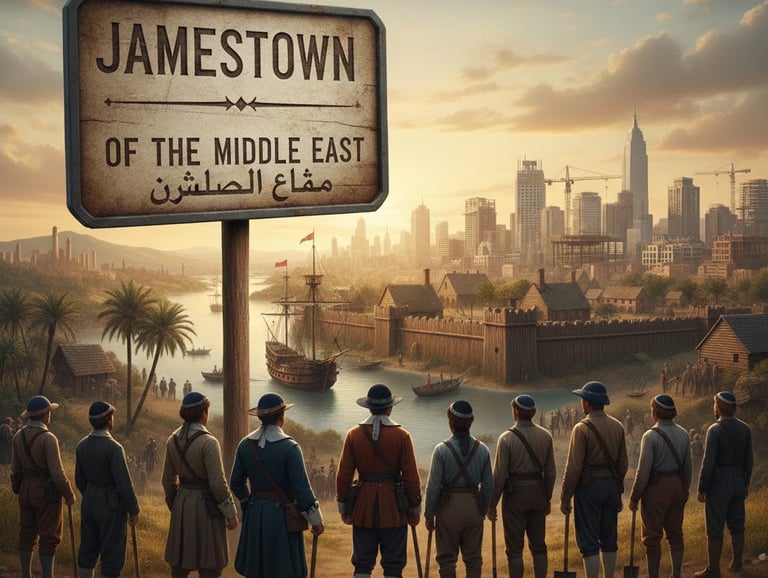
Before these slogans existed, empires created distant settlements protected by powerful sponsors. Jamestown was England’s beachhead. Critics argue Israel plays a similar strategic role for the U.S. today. The context doesn’t justify violence — but it explains the rhetoric.
The slogan “Death to Israel” and “Death to America” is often interpreted in the West as a call for literal destruction. But to understand why militant groups and segments of the Middle Eastern public use it, you have to understand the political story behind it — a story rooted in how people historically view settler colonies and the empires that support them.
One historical analogy appears repeatedly in academic writing, Middle Eastern political commentary, and insurgent propaganda:
Israel is the Jamestown of the Middle East, and the United States is the United Kingdom.
It’s not about literal equivalence — it’s about the structure of power.
Jamestown: A beachhead for an empire
Jamestown was not merely a town. It was England’s strategic outpost — the first permanent English colony in North America. Its purpose was not survival for its own sake, but expansion, resource extraction, and anchoring empire on new land.
Jamestown settlers:
relied completely on England for materials, weapons, and legitimacy,
viewed the surrounding territory as land to expand into,
believed they had a biblical duty to manifest destiny,
were violently resisted by the local populations who saw them as an existential foothold of foreign control.
From the perspective of the Powhatan Confederacy, Jamestown wasn’t a community.
It was the beginning of a process that eventually displaced them from their land entirely.
This is the historical memory many Middle Eastern political thinkers invoke.
Why some in the Middle East apply this model to Israel
The analogy goes like this:
Israel = Jamestown
A settler population backed by a faraway superpower, placed in a strategic location, reliant on foreign support for military survival and political legitimacy.United States = The British Empire
A global power funding, sustaining, arming, and politically shielding a smaller outpost that aligns with its strategic interests.
This framing is why groups like Hezbollah, Hamas, and the Iranian government couch their rhetoric in anti-imperial terms. In their worldview, opposition to Israel becomes indistinguishable from opposition to the superpower that they believe enables its existence.
Critics fear that the methods used against Indigenous populations in early American history — forced displacement, dependency on controlled resources, engineered scarcity — could be echoed in modern conflicts where one side has overwhelming firepower.
Why the UK supported Jamestown — and the parallel people point to today
England didn’t bankroll Jamestown out of charity. It supported it because:
it offered a strategic foothold,
access to new resources,
a way to project power overseas,
and a buffer against rival European empires.
This is the structural parallel that Middle Eastern critics emphasize:
The U.S. sees Israel as a stable ally in a volatile region,
a site for projecting military influence,
a partner in intelligence and technology,
and a counterweight to adversaries like Iran.
To those who view American presence as imperial, Israel looks like the “first colony” — a beachhead for American influence in the region. Again, this is their framing, not a factual claim that Israel was literally founded as a colony. It’s a geopolitical metaphor used by both supporters and critics.
Why this analogy matters — but also has limits
The Jamestown analogy explains anger, rhetoric, and regional narratives — but it doesn’t predict or justify violence.
It is a way to understand:
why the slogans pair Israel and America together,
why critics view settlements as expansionist,
why U.S. support shapes perceptions of occupation,
and why the conflict feels “imperial” to many in the region.
But the analogy breaks down in major ways:
Israel is a sovereign state, not a colony.
Americans do not rule Israel, nor extract resources.
Israelis are not agents of an empire in the formal sense.
Modern geopolitics isn’t 1607 Virginia.
Still, perception drives conflict more than fact — and this analogy is one of the most powerful perceptions in Middle Eastern discourse.
Bottom Line
People say these slogans not because they’re thinking about citizens, but because they view Israel and the United States as a linked imperial structure, just as Jamestown and England were linked in the 1600s. Understanding the analogy doesn’t excuse extremism — it simply reveals the strategic narrative behind it.