
Trump Signals Move From Sea Strikes to Land Targets — Raising Major Questions About Legal Authority
TRENDINGPOLITICS
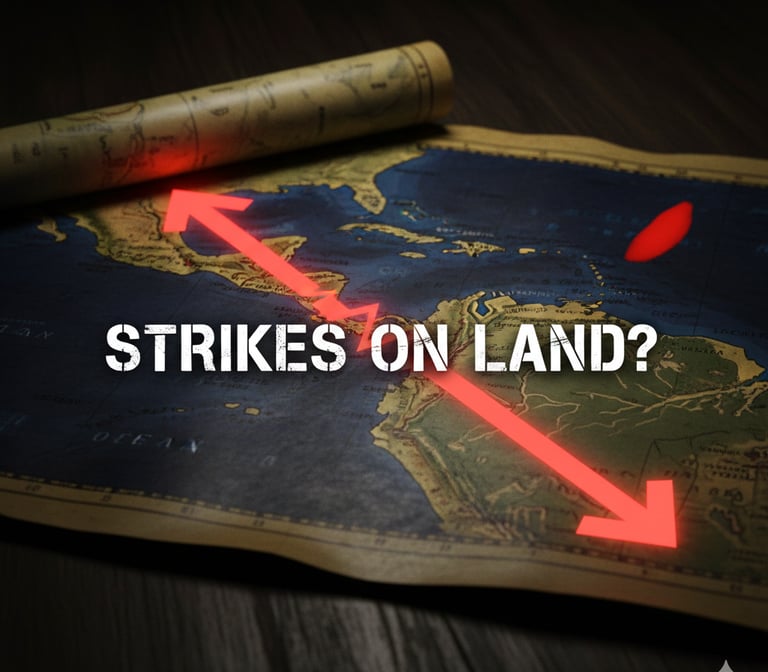
Trump hinted the U.S. could strike land-based drug sites abroad, not just vessels at sea. That shift would redefine Washington’s use of force, test the limits of presidential war powers, and escalate tensions with nations already uneasy about the boat-strike doctrine.
Trump’s New Line: “We’re Going to Start Doing Those Strikes on Land, Too.”
In recent remarks first reported by multiple outlets, President Donald Trump suggested that the U.S. military’s controversial boat-strike campaign — originally framed as a maritime interdiction effort targeting suspected drug-trafficking vessels — may soon expand to land-based targets.
The confirmed quote:
“We’re doing these [sea] strikes… and we’re going to start doing those strikes on land, too.”
That single sentence signals a potential escalation far beyond the legal framework used to justify attacks on vessels in international waters.
What This Actually Means (Not Politically — Logically and Legally)
1. Hitting Boats Is One Thing — Hitting Land Is a Completely Different Legal Universe
Boat strikes are justified through a mix of:
Maritime drug-interdiction laws,
The 1988 UN Drug Convention,
And the broad U.S. argument that stateless vessels can be targeted in international waters.
But none of that transfers cleanly to land.
Hitting land-based targets requires one of the following:
A) Consent from the foreign government
Example: Colombia, Mexico, or Venezuela would need to explicitly allow U.S. munitions on their soil.
This is politically unlikely.
B) AUMF-style congressional authorization
There is no anti-cartel AUMF. Congress has not authorized a global war against narcotics networks. Buying time with executive power alone is legally shaky.
C) Article II self-defense claim
The president might claim drug trafficking constitutes an “imminent threat.”
But legally, drugs aren’t classified as armed attacks under international law.
This would be the most controversial path.
2. Striking Land Could Be Interpreted as Violating Sovereignty
Under international law, using force inside another country without its approval is typically:
A violation of territorial sovereignty
An act of war unless justified by self-defense
Even U.S. allies could revolt politically if Washington acts unilaterally.
This is where analysts say the legal footing becomes “extraordinarily thin.”
3. It Sets a Global Precedent Other Nations May Copy
If the U.S. claims the right to strike “drug-linked infrastructure” in another country without war, without consent, and without a direct armed threat, it creates a precedent that:
China could cite for “terrorist havens” abroad
Turkey could cite for Kurdish areas
India could cite for Pakistan-based militants
This is why foreign-policy academics are calling Trump’s hint a “pre-doctrine moment.”
4. The Domestic Legal Battle Would Be Immediate
Expect:
Lawsuits
Congressional hearings
Military lawyers objecting internally
Human-rights groups filing injunctions
Foreign governments filing diplomatic protests
Presidents have wide latitude at sea.
But on land? Courts tend to intervene.
This becomes a test of presidential war powers vs. constitutional limits.
5. The Real Question: What Counts as a “Drug Target”?
The ambiguity is intentional.
Could the U.S. hit:
A suspected cartel warehouse?
A drug lab in the jungle?
A compound where an intelligence report suggests fentanyl precursors are stored?
None of these fall under any existing authorized conflict.
Without clear definitions, the policy becomes open-ended — and critics say that’s the danger.
Implications for Aporia Readers
This is bigger than a single quote.
It’s a potential turning point in how — and where — the U.S. projects force.
A shift from maritime interdiction to land-based strikes would:
Break decades-old norms
Expand executive power
Trigger new geopolitical friction
Create legal battles inside and outside the U.S.
And establish a doctrine future presidents could inherit
The headline is simple:
America may be moving toward a new model of extraterritorial force — without the legal foundation that normally backs it.