Observers watching from abroad have a simple question: why is the American public being told the opposite of what the footage shows?
To an outside observer, the case of Derrick Manigault presents a straightforward sequence of events. A man is followed into a store. He tries to leave. He is shot in the back by a plainclothes police officer. He dies.
In most countries, this sequence would trigger an independent investigation, a public inquiry, and likely criminal charges. In Gastonia, North Carolina, it triggered a press release. The officers were cleared. They returned to work within months.
What is perhaps more striking than the shooting itself is the machinery that followed it — legal, institutional, and social — and how efficiently it converted a man shot in the back into a justified homicide.
What the Footage Shows
On January 10, 2026, two plainclothes Gastonia police detectives were inside Jakob’s Food Mart on Gaston Avenue conducting an undercover alcohol compliance operation. Derrick Manigault, 39, arrived at the store separately.
The confrontation Manigault found himself in was not one he started. A man named David Sanders argued with Manigault in the parking lot, then followed him inside the store and continued pressing the confrontation — walking up to his face, refusing to disengage.
Manigault issued a warning: “You trying to lose your life tonight?” American media reported this line as evidence of Manigault’s aggression. Viewed without that framing, it reads as what it was — a man being crowded telling his pursuer to back off.
When Sanders continued to advance, Manigault drew what appeared to be a firearm. The confrontation de-escalated. Manigault then made the decision to leave the store entirely.
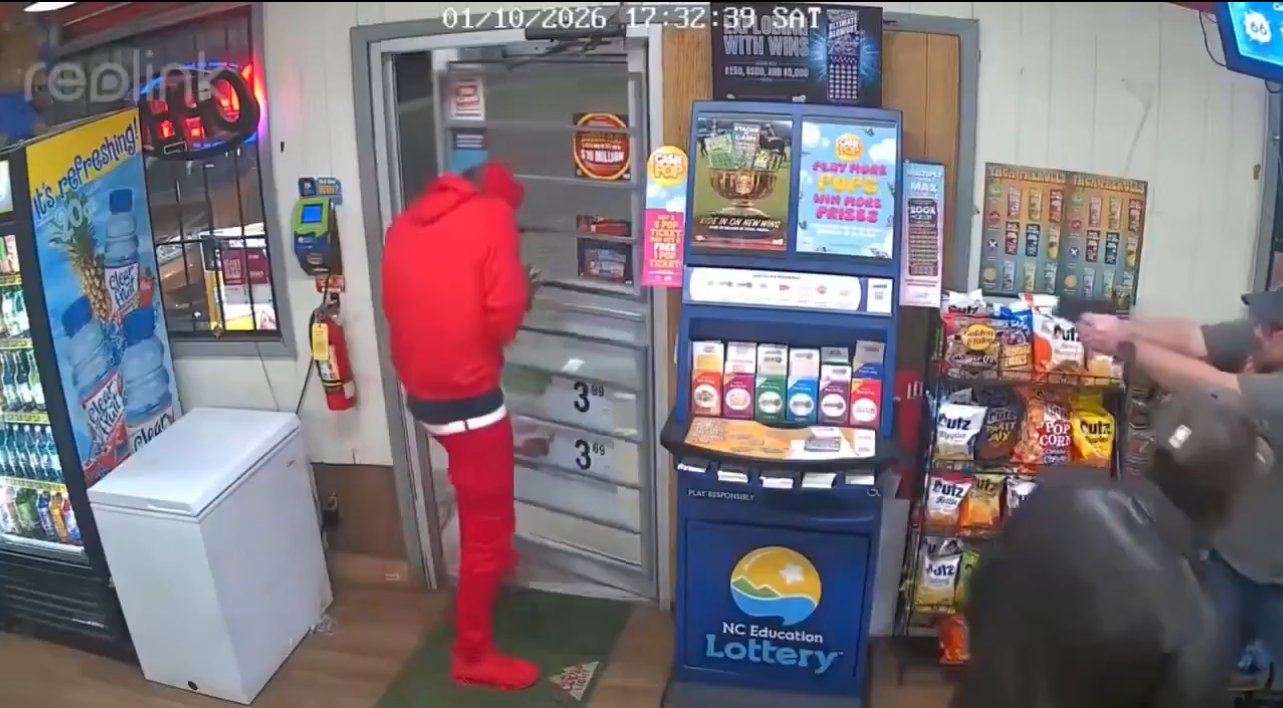
The surveillance footage — the only visual record, as neither officer was wearing a body camera — shows Manigault at the exit door. Red hoodie, red pants. Gun at his side, pointed at the floor. One hand on the door. Walking out in a normal gait.
That is when the undercover officer fired. Manigault was shot in the back.
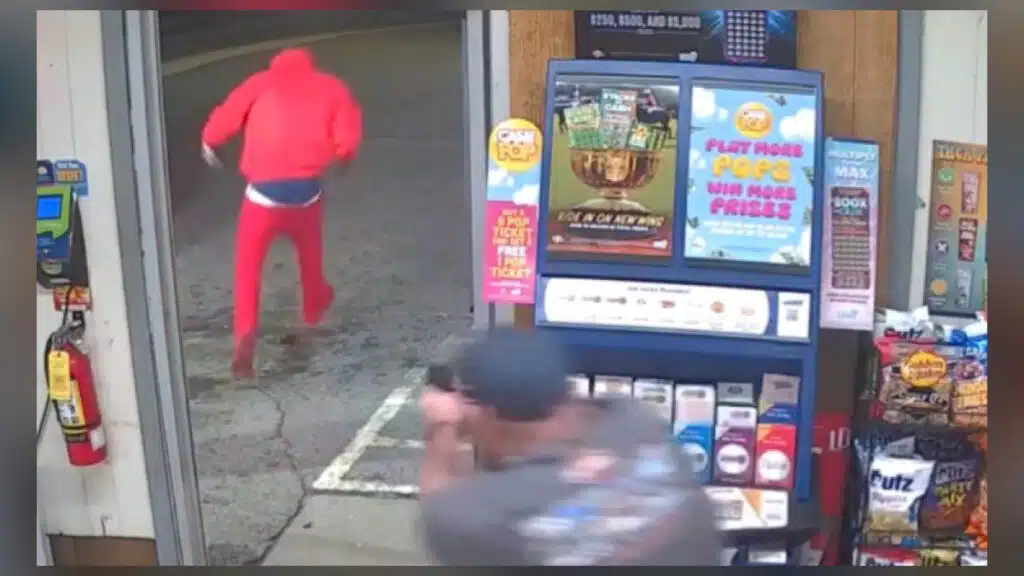
The second officer, positioned outside, then fired additional rounds. Manigault sustained four gunshot wounds. He died in hospital two days later. The firearm he had been carrying was later confirmed to be a replica.
The Narrative Inversion
What happened next is worth examining carefully, because the official account does not describe the same event the footage records.
The Gastonia Police Department stated that officers responded to a man “waving a gun and making threatening movements.” The District Attorney’s report described Manigault as having “intentionally presented the fake firearm as a real weapon” and determined that officers reasonably perceived an immediate deadly threat.
The footage shows a man leaving.
This is not a matter of interpretation. The still frame from the store’s interior camera, timestamped 17:32:39, shows Manigault facing the exit, one hand on the door, mid-step. The gun is not raised. It is not pointed at anyone. He is in the act of departing.
The gap between the official description and the visual record is not subtle. It is total.
The Legal Standard That Closes Every Case
American law enforcement operates under what is known as the “reasonable officer” standard — a doctrine established by US courts that asks not what actually occurred, but whether a hypothetical reasonable officer could have perceived a deadly threat in that moment.
District Attorney Travis Page applied this standard to clear both officers. His report cited the US Constitution’s provision that officers need not “gamble with their lives in the face of a serious threat of harm.”
To outside observers, this standard is remarkable in its design. It is constructed to be nearly impossible to overcome. So long as an officer can articulate a fear — regardless of whether the subject was retreating, regardless of whether the weapon was raised, regardless of what the camera shows — the use of deadly force becomes legally unassailable.
Under this framework, the direction a person is moving when shot is legally irrelevant. Whether they were leaving or advancing does not change the analysis. The officer’s stated perception is the entire inquiry.
This is the standard under which Derrick Manigault, shot in the back while walking out a door, was determined to have caused his own death.
The Absence of Accountability Mechanisms
Several details compound the concern.
The officers were in plain clothes. Under department policy, plain-clothes officers are not required to wear body cameras. There is therefore no body camera footage of this shooting — only the store’s corner-mounted surveillance camera.
According to Manigault’s wife, Rebecca Insley, who watched the full footage, no verbal commands were issued before the first shots were fired. “There were no verbal commands. There was nothing to comply with,” she stated publicly.
The claim by the second officer — that he fired because he believed Manigault raised his arm to return fire — becomes difficult to evaluate given that Manigault had already been shot from behind and may have been stumbling when this perceived “raising” occurred.
The officers were not named publicly. They were placed on paid leave during the investigation. They are now back at work.
How the Story Was Rewritten Online
Within 48 hours of the footage’s public release, a social media post captioned the clip “no hesitation, just affirmative actions.” It accumulated 3.5 million views.
The phrase “affirmative actions” is an American political dog whistle — a reference to race-based employment policy, used here to imply that Manigault’s death was a corrective or a joke. The comment sections that followed mocked African American vernacular speech as a proxy for expressing that the victim’s life was without value.
This reframing is worth examining not as an emotional matter but as an informational one. The factual record is clear: Manigault was followed, warned his pursuer, de-escalated, attempted to leave, and was shot in the back. That record is not in dispute — it is visible on camera.
The online response did not engage with this record. It replaced it. The question “why was a retreating man shot in the back?” was never asked, because the audience had already been directed toward a different question entirely.
This is the function of the framing. Not to lie, exactly, but to ensure the accurate sequence of events never becomes the story.
The Question Outside Observers Are Asking
In jurisdictions with independent prosecutorial oversight, civilian review boards with real authority, or mandatory body camera requirements for all officers regardless of dress, this case would look different. The investigation would not be conducted by the same state apparatus that employs the officers. The legal standard applied would not be one that renders retreating victims legally equivalent to threats.
The United States routinely issues human rights assessments of other nations’ police conduct. Those assessments cite lack of accountability mechanisms, absence of independent oversight, and the use of legal standards that functionally immunize officers from prosecution.
Outside observers watching the Manigault case have a simple question: why does the footage show one thing and the official record describe another? And why, when the footage is public and the discrepancy is visible, is the conversation online about something else entirely?
What the Record Shows
Derrick Manigault was followed into a store by a man who would not leave him alone. He issued a verbal warning. He drew a weapon to create distance when the warning failed. When the situation de-escalated, he chose to leave.
He was shot in the back while walking out the door.
The DA called it justified. The officers are back at work. His wife is still pushing for accountability.
The footage is public. The still frame exists. The door is right there in the image, and so is Manigault — mid-step, leaving.
Whatever legal standard was applied to close this case, the camera does not grade on a curve.
Derrick Manigault was 39 years old.
What Happened, In Order
- A man follows Derrick Manigault into a convenience store and gets in his face
- Manigault tells him to back off
- The man keeps coming
- Manigault pulls out a gun to create distance — it works
- Manigault decides to leave — gun at his side, pointed at the floor, hand on the door
- An undercover cop shoots him in the back
- A second cop outside shoots him again
- Manigault dies in the hospital two days later
- The gun turns out to be a replica
- The DA says the officers were justified — no charges filed, they go back to work
That’s it. That’s the whole thing.